


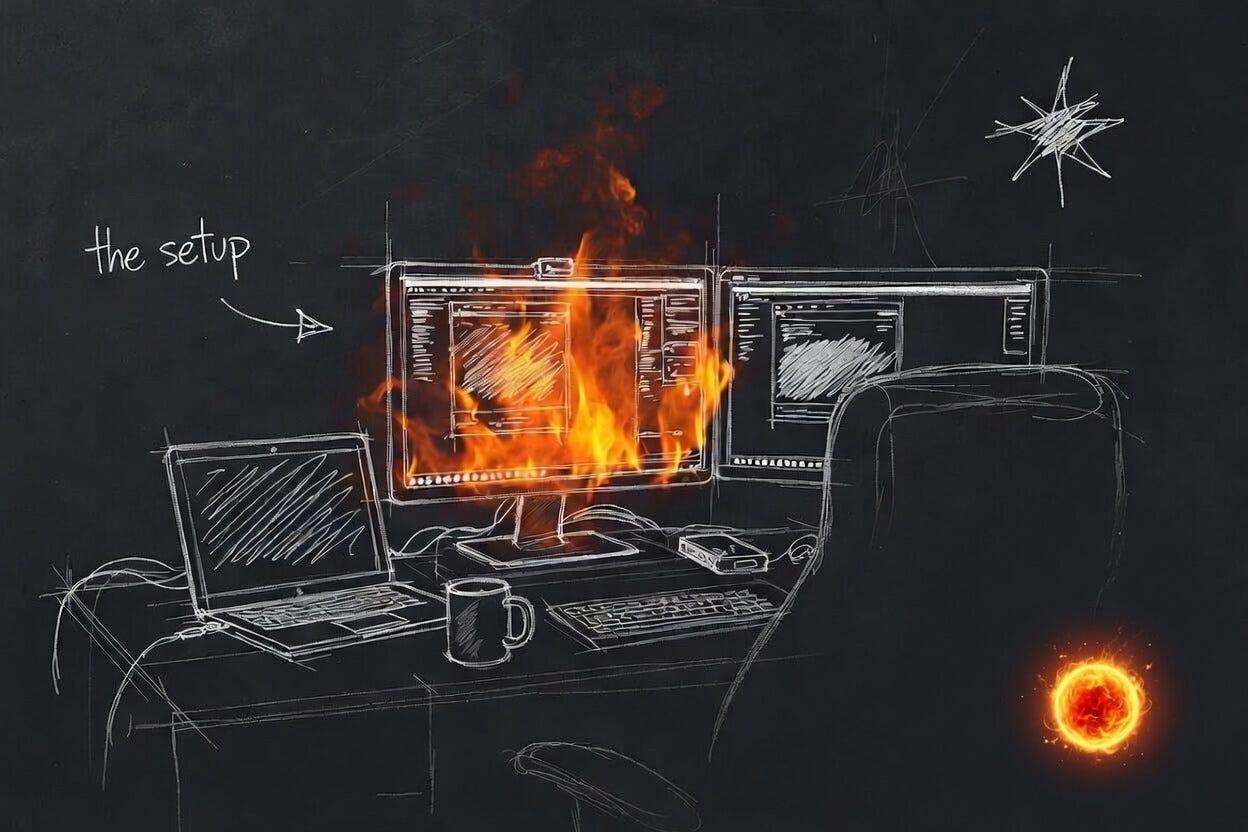
Here’s what nobody shows you when they talk about working with AI: the desk.
You picture one person, one laptop, one chat window. That’s how it starts, and for a long time that’s all you need. But once you’re really in it, building things, the work spreads out. Mine sits across three screens, and they’re not fixed in place. They shift depending on what the day asks for.
First, the desk itself. It’s a standing desk, an Uplift, and I move it up and down through the day. My wearable nudges me when I’ve been sitting too long, or standing too long, on the days I’m home and not traveling. Sounds small. It isn’t. These are long sessions, and the body keeps the head working. That part is setup too.
Left and right, I run agents. Think of an agent as AI you’ve pointed at a job and let go work, instead of going back and forth in a chat. One on each side. The middle screen is home base. That’s where the standard stuff lives, email, the office work, the thing I’m actually building that day. If I need my right-hand agent up while I work in the middle, I split the center screen, work in one half and keep email in the other. The setup bends to the task.
Most mornings I direct. I start with my prompt. I run my morning brief, it sets up the day and reviews my email, and I go from there. Getting that brief to run right took setup, and that’s the part I want you to hear.
If the day turns into building, I push coding sessions out to the left and the right and run two at once. Some days the center screen becomes a third build session and I’m running three. It just depends on the need. When I want to think bigger instead of build, I move out of the work and into Claude.ai, into my project folders, and do the larger strategy session there. The screens are rooms. I walk between them depending on what I’m doing.
Here’s the part I can’t say loud enough. The boring setup is what makes it run. An hour getting your files in order and writing down how you work once, so the AI starts every morning already knowing you instead of you explaining yourself from scratch. It’s the least exciting work you’ll do and it matters most. Skip it and every session fights you. Do it and the whole thing runs quiet.
You don’t get this right on day one. Nobody does. You learn as you go, by hitting the wall and fixing the one thing that broke. Whatever it is you’re setting up, jump in. The dog doesn’t bite. You’ll stumble and fall a few times, point the wrong agent at the wrong job, lose your place between screens. Everybody does. Then it clicks.
If this one resonates, send me a message. I’ve got a prompt and some basic instructions that set most of this up for you. Too long to drop in here, but the more we share, the more we all learn.
And when it clicks for you, say so. Share what you figured out. That’s how the rest of us learn, especially those of us who aren’t engineers, just running a business or starting one and figuring it out in real time. You learn every day. Pass it on.
Next week, Part 6.
Matt
LavaHopper AI, minus the hype.