


Most people use AI wrong. Not because they’re not smart. Because nobody told them there was another way.
Here’s the way almost everyone uses it. You open a chat. You type a question. You read the answer. You close the tab. It felt like a smarter search engine, so that’s what you filed it away as. A faster Google. A party trick.
And then you hear someone say AI changed how they work, and you think they’re exaggerating, or you think they’re a programmer, or you think they’re lying. Because the thing you tried was fine. Useful, sometimes. Not life-changing.
I get it. That was me a year ago.
Then I spent six months running a medical device company with these tools open all day, every day. Not as a hobby. As the actual way the work got done. And somewhere in there it stopped being a search bar and became something I don’t have a good word for. A teammate is the closest I can get. Not a metaphor I’m reaching for. The closest honest description.
Let me show you the difference, because it’s smaller than you think and it changes everything.
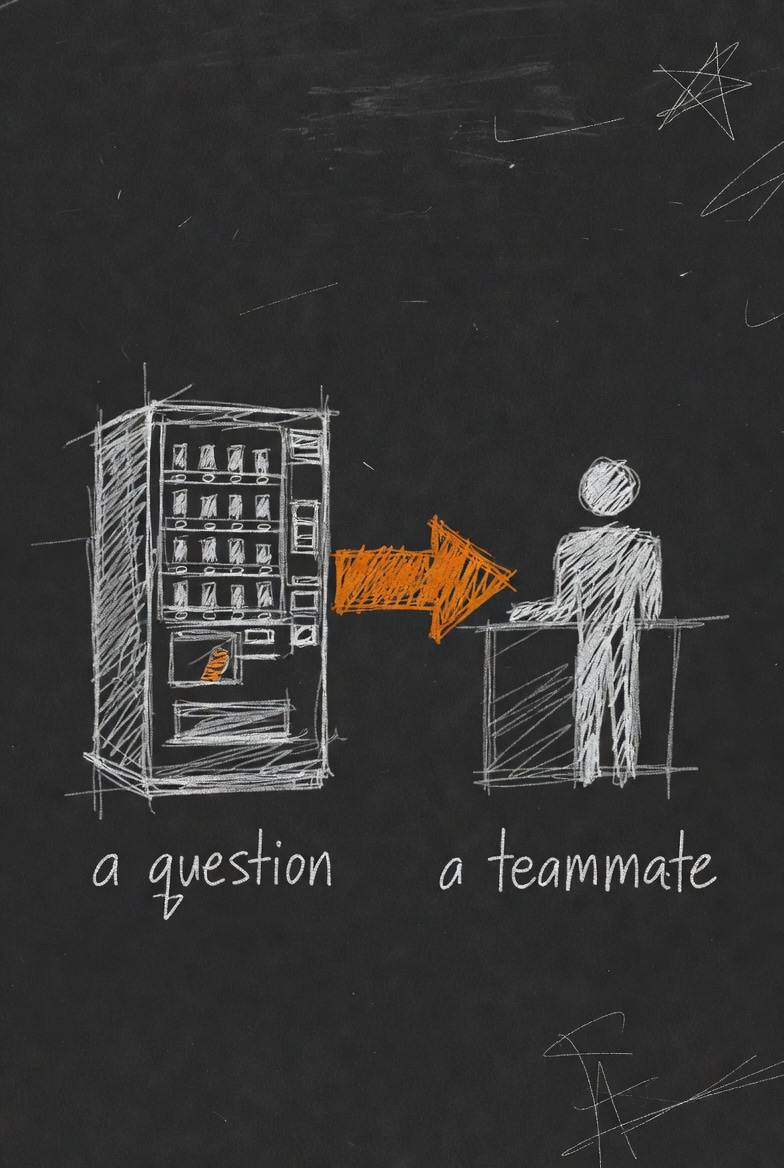
The vending machine vs. the new hire
When you ask AI a question, you’re treating it like a vending machine. Money in, snack out. One transaction. No relationship. You wouldn’t expect a vending machine to know your business, so you don’t give it any context, and it gives you a generic answer, and the generic answer confirms what you already believed: this thing is generic.
When you put AI to work, you treat it like a new hire on day one. A sharp one. Fast, tireless, weirdly well-read, but knows nothing about you yet. So you do what you’d do with any good new hire. You tell it what you’re trying to do. You show it an example of what good looks like. You tell it the format you want it back in. And then you don’t accept the first draft as final. You react to it. You push back. You say “closer, but more direct” and “you missed the part about pricing” and “rewrite the opening, it’s soft.”
That’s it. That’s the whole secret. Context, a standard, and a back-and-forth instead of a one-shot.
The vending machine gives you a snack. The new hire, by Friday, is doing things you didn’t have to explain twice.
Here’s what that actually looks like
Watch the same task done both ways.
The vending-machine version:
Write a follow-up email to a customer.
You’ll get something. It’ll be grammatically perfect and completely dead. “I hope this email finds you well. I wanted to follow up regarding our recent conversation.” You’ve gotten a hundred of those. You delete them without reading. So does your customer.
The put-it-to-work version:
You’re helping me follow up with a customer named Dana who runs a 12-person dental practice. We talked last Tuesday about helping her get her patient intake forms out of paper and into something digital. She was interested but worried it’d be a huge project that disrupts her front desk. I want to reassure her it’s small and low-risk and offer a 20-minute call this week. Keep it short, warm, no corporate filler, sound like a real person who remembers the conversation. Two sentences of substance, then the ask.
Now you get an email that sounds like you talked to Dana. Because you told it about Dana. The model didn’t get smarter between those two prompts. You did the smart part. You gave it what it needed to do the job.
That gap, between the first version and the second, is the entire ballgame. Everything else in this series is just teaching you to live in the second version on purpose.
“But doesn’t this make you stop thinking?”
This is the objection I hear most, and I want to take it seriously because I had it too.
The fear is that if the machine does the thinking, your own thinking atrophies. And honestly, if you use it like a vending machine, that’s a real risk. Ask it a question, paste the answer, never engage. Sure. That’ll rot you.
But that’s not what putting it to work is. Look back at that Dana email. To write the good prompt, I had to know who Dana is, what she actually needs, what she’s afraid of, and what I want to happen next. The AI can’t supply any of that. I have to think harder, not less, to use it well. The thinking moves up a level. I stopped doing the typing and started doing the judging. What to ask for. Whether the answer is any good. What’s still missing.
That’s not less thinking. In my experience it’s more, and better, because the busywork that used to eat the hours is gone and what’s left is the part that needs a human.
The people who’ll get hurt by AI aren’t the ones who use it. They’re the ones who use it badly and the ones who refuse to touch it. The middle, where you stay in charge and let it carry the load, is the safest and strongest place to be.
What this series is going to do
This is the first of ten. By the end you won’t just understand AI, you’ll be able to work with it. We go foundations first, then we build.
Next few pieces stay close to the ground and earn your trust: how to write a prompt that actually works, why iterating beats one-shotting, and which tool to reach for which job, because there’s more than one and almost nobody explains the difference plainly. Then we climb. The real setup, the one with the screens. Turning a task you do every week into something you build once and reuse forever. Handing actual work to AI agents and watching them do it. And at the very end, the operator-level stuff: trusting AI with real decisions, where it helps, and exactly where it’ll burn you.
I’m not writing this from theory. I’m writing it from six months of doing it for real, in a business where being wrong is expensive, while also being a father who’d rather not work until midnight. Every piece in here is something I actually do.
So here’s your one assignment from Part 1. Don’t go learn anything. Just, the next time you open AI, don’t ask it a question. Give it a job. Tell it who you are, what you’re trying to do, and what good looks like. Then talk to it like it’s the new hire, not the vending machine.
You’ll feel the difference in about ninety seconds.
That feeling is the whole reason this series exists.
This is Part 1. Next week, Part 2: how to write a prompt that actually works. No course, no jargon, just the three things that make the difference.
Written by Matt at LavaHopper. I spent the last six months learning to actually work with these tools while running a company and raising three kids, the first of whom heads to college this fall. I’m sharing what I found, one piece at a time, for free, because nobody should have to spend money they’re saving for rent or tuition to learn the basics of this.
If this was useful, subscribe so you get the next one. There are nine more coming.
Find me here: Substack Matt Cronin · LinkedIn Matt Cronin · LavaHopper.ai
Thank you for taking the time to comment and I am glad you enjoyed. Matt
Great stuff Matt