


Here is something almost nobody tells you when you start using AI. It does not read words the way you do.
Before it does anything at all, it chops your text into little chunks called tokens. Then it just guesses the next chunk, over and over, very fast. That is the whole trick under the hood.
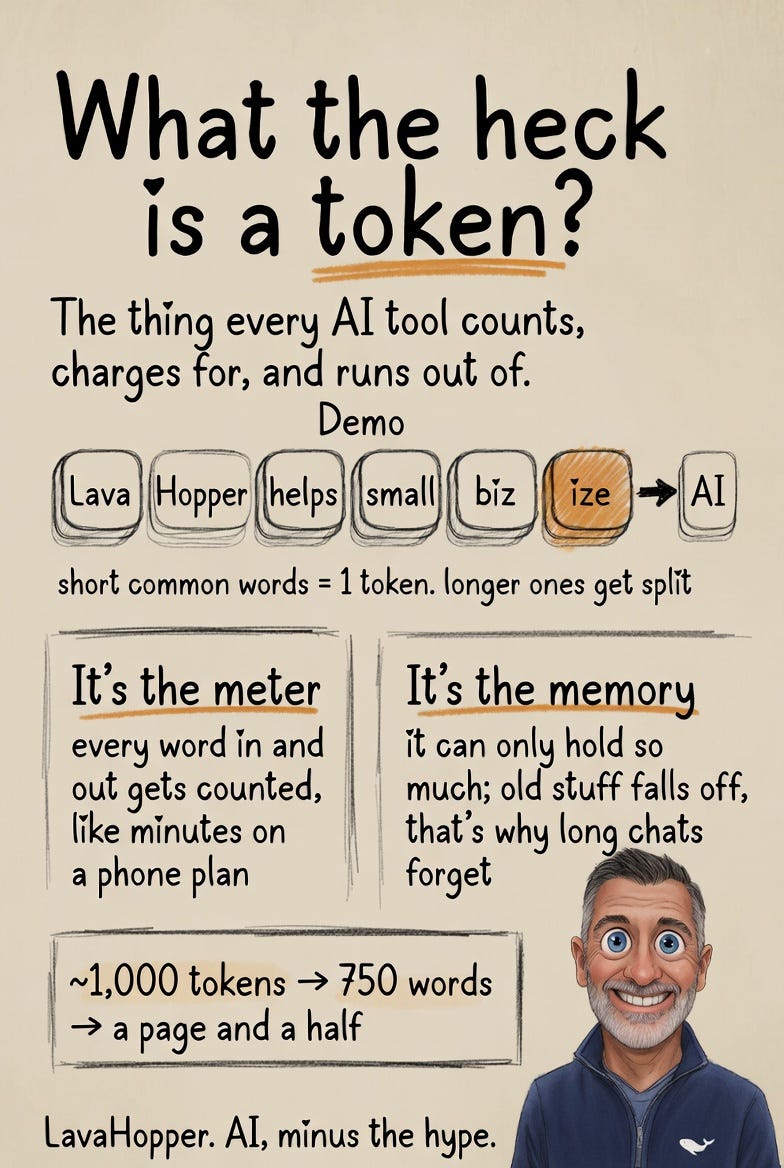
A token is not quite a word. Short common words are usually one token. Longer or unusual ones get broken into pieces. Even spaces and punctuation count. Take the word “tokenize.” The model might split it into “token” and “ize,” two tokens for one word.
You do not need to track any of that by hand. But you do need to know two things tokens control, because they explain a lot of weird AI behavior.
Tokens are the meter. Every chunk going in, and every chunk coming back, gets counted. Think of it like minutes on an old phone plan. More tokens, more cost. This is true even on the free tools. You just are not the one getting the bill.
Tokens are the memory. A model can only hold so many tokens at once. That limit is called its context. Go past it and the earliest stuff drops off the back. That is why a long chat sometimes feels like the AI forgot what you told it at the start. It did. It ran out of room.
Here is the only number worth remembering.
About 1,000 tokens is roughly 750 words. Call it a page and a half.
So why does this matter to you, practically?
Because the demos that make AI look almost free are using tiny prompts. A one line question barely costs anything. But real work is different. The moment you start feeding in documents, long context, spreadsheets, or code, the token count climbs fast. Often much faster than people expect. That gap, between the cheap little demo and the real workload, is exactly where the surprise bills live.
Knowing this does not require any math. It just changes how you think. When something feels expensive or forgetful, now you know why. It is the tokens.
On Tuesday, we go one layer deeper. Where the tokens actually go in a real task, and a few simple ways to spend fewer of them.
Matt
LavaHopper AI, minus the hype.
Great installment. Looking forward to the next.