


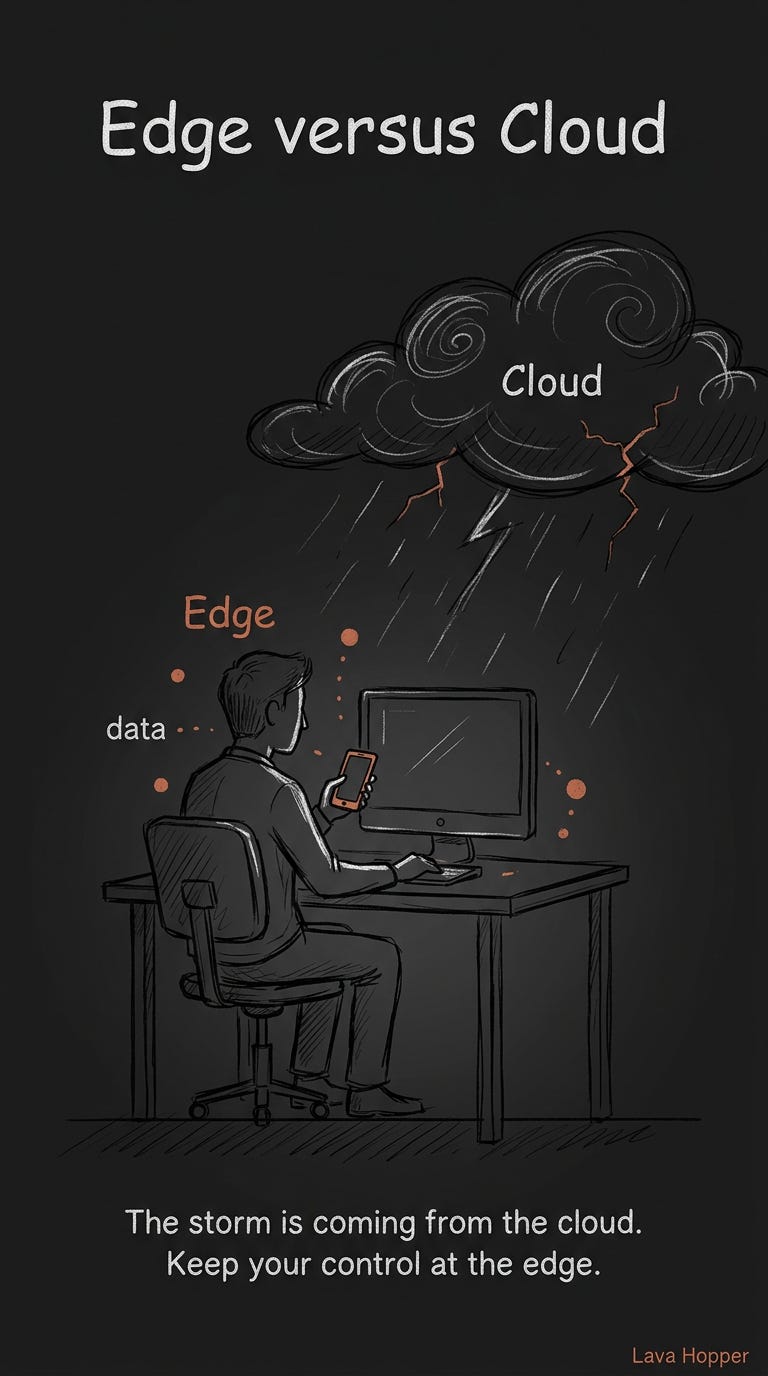
Keep it grounded at the edge
Before we talk about Claude, Perplexity, and the hyperscalers, start here:
Keep as much as possible grounded at the edge.
Keep a local copy of your data and your critical workflows. Use the cloud as a tool, not the entire floor you stand on. The minute your AI stack quietly decides to push your work out to someone else’s cluster, you are not in control anymore. Most people do not even know what “the cloud” really is, but their IP, notes, and decisions now live there by default.
Right now, you have an entire cottage industry of experts telling you how to wire everything into hosted AI: how to connect your stack, sync all your docs, and run your business inside someone else’s infrastructure. They make money on likes, clicks, subscriptions, and consulting, while they tell you to expose more of your system and more of your data.
What they are not talking about is the risk that comes with that. They do not talk about what happens when the providers’ economics change, when infrastructure spend slows down, or when a platform quietly swaps the model or limits your access. If you hand everything to the cloud and the ground moves, you are the one who gets the rug pulled out from under you.
So the first rule is simple: keep what you can on your side of the wire. Edge first. Cloud when it earns the trust, not by default.
The system is moving under your feet
I run my work on AI. I am not a casual user dropping in once a week. I am an operator building and steering real projects through systems like Claude, Perplexity, and others, every single day. When you live inside these tools, you see something most non‑technical users miss.
The system is different lately.
Same prompts, similar contexts, same model labels. Yet behavior is unstable. Some days you get crisp reasoning, clean structure, and grounded answers. Other days, you get shallow responses, subtle hallucinations, or the sense that the model is just churning. You can feel it burning tokens without delivering proportional value.
This is not just “you need better prompts.” It is what happens when an economic system under extreme pressure leaks directly into the product.
The invisible strain behind your chat window
Behind the friendly chat interface are some very large numbers. The major hyperscalers are guiding toward hundreds of billions of dollars of AI‑related capital expenditure in 2026, with estimates clustering around roughly 725 billion dollars, up sharply from about 410 billion dollars in 2025. Almost all of that is going into data centers, GPUs, custom chips, and power, industrial‑scale infrastructure to keep the models running.
At the same time, analysis of their financials shows a mismatch. Operating cash flow across these companies is growing at roughly 23 percent per year, while cash capex is growing at about 70 percent per year, with projections that total cash capex will exceed operating cash flow around the third quarter of 2026. In other words, the infrastructure spend is on track to outrun the core cash the businesses generate.
This mismatch does not stay in an earnings deck. It turns into practical decisions about how your queries are handled and how much computation you are allowed to consume.
Inference economics and the quality you see
Running these models is expensive. As competition intensifies, providers cut token prices while usage explodes. Cheaper alternatives, particularly open‑weight models and lower‑cost ecosystems, can deliver good enough performance on many tasks at a fraction of the cost, and some analyses flag them as a real threat to frontier margins.
If you are a heavy user, you feel the response to that pressure:
• Requests get routed between stronger and weaker variants of the same brand without you being told.
• Quantization, context trimming, and shorter reasoning show up at the edges of your prompts.
• Spend controls and throttling quietly shape how much computation you get per query.
• Constant live experiments mean “Claude” or “ChatGPT” is not one fixed thing, but a moving target.
From the outside, this looks like inconsistency. From the inside, it is cost optimization.
And while all this is happening, the expert class keeps publishing how‑to threads that assume the ground is stable: connect everything, sync everything, push your whole business into someone else’s stack. They rarely ask a more basic question:
What happens when the money that keeps those stacks running starts to tighten?
When capex slows and the rug moves
If the capex cycle slows, if token pricing pressure keeps gnawing at margins, and if investor appetite for endless infrastructure spend cools, something has to give. You will not see it first in the marketing. You will see it in:
• Reduced reliability and more aggressive caching.
• Harder limits on context and throughput.
• Quiet model swaps that favor cheaper inference over quality.
• Entire products getting sunset, heavily paywalled, or rate‑limited in ways that break your workflows.
That is when people who pushed everything into purely cloud‑dependent AI, without local backups or edge alternatives, discover what vendor risk really means. They are exposed to a change in someone else’s capital allocation, and they realize too late that they handed over both their workflows and their data.
You do not want to be in that position.
Bring control back to the edge
So here is the practical reminder I would put at the top of every conversation about AI:
• Use local and edge tools where you can. Keep copies of your data and your processes on your own hardware.
• Treat cloud AI as a powerful tool, not as the only floor you stand on.
• Assume the economics behind your favorite model can and will change.
• Design your systems so that if a provider limits you, raises prices, or degrades quality, you can pivot without losing yourself.
These systems can do remarkable things. They can also turn into over‑sold party tricks glued onto a search bar if the funding and infrastructure behind them wobble. Your responsibility is not to worship the tools. It is to protect your business and your data.
A call out and a warning
Whether you are a believer in Elon Musk or not, we do need strong actors who are willing to tackle this reliability gap head on. If any platform wants to claim it is different, the bar is not just to be more entertaining or more uncensored. The bar is to design in a way that does not turn users into test subjects whenever someone needs to save money.
Come on Elon. Help fix this. Not by joining the same arms race and pretending everything is fine, but by admitting that the ground is moving and building a platform that treats stability and user control as non‑negotiable.
Because here is the reality:
The capex dollars from the large strategics will not grow forever. When they slow, or when markets force discipline, many of the current systems will be exposed. Their compromises, shortcuts, and quiet cost games will show up clearly. That is when people who handed everything to the cloud will feel the rug pulled out from under them.
Do not wait for that moment to remember you used to have control.
Take it back now. Keep data at the edge where it makes sense. Build in checks and balances. Treat the so‑called experts with a lot more skepticism than their follower counts deserve. Use AI as a tool, not a trap.
When the model shifts under you, it is too late to rebuild the floor.
Signed,
Lava Hopper